

America Needs an Intervention
Militarism USA Must Be Ended

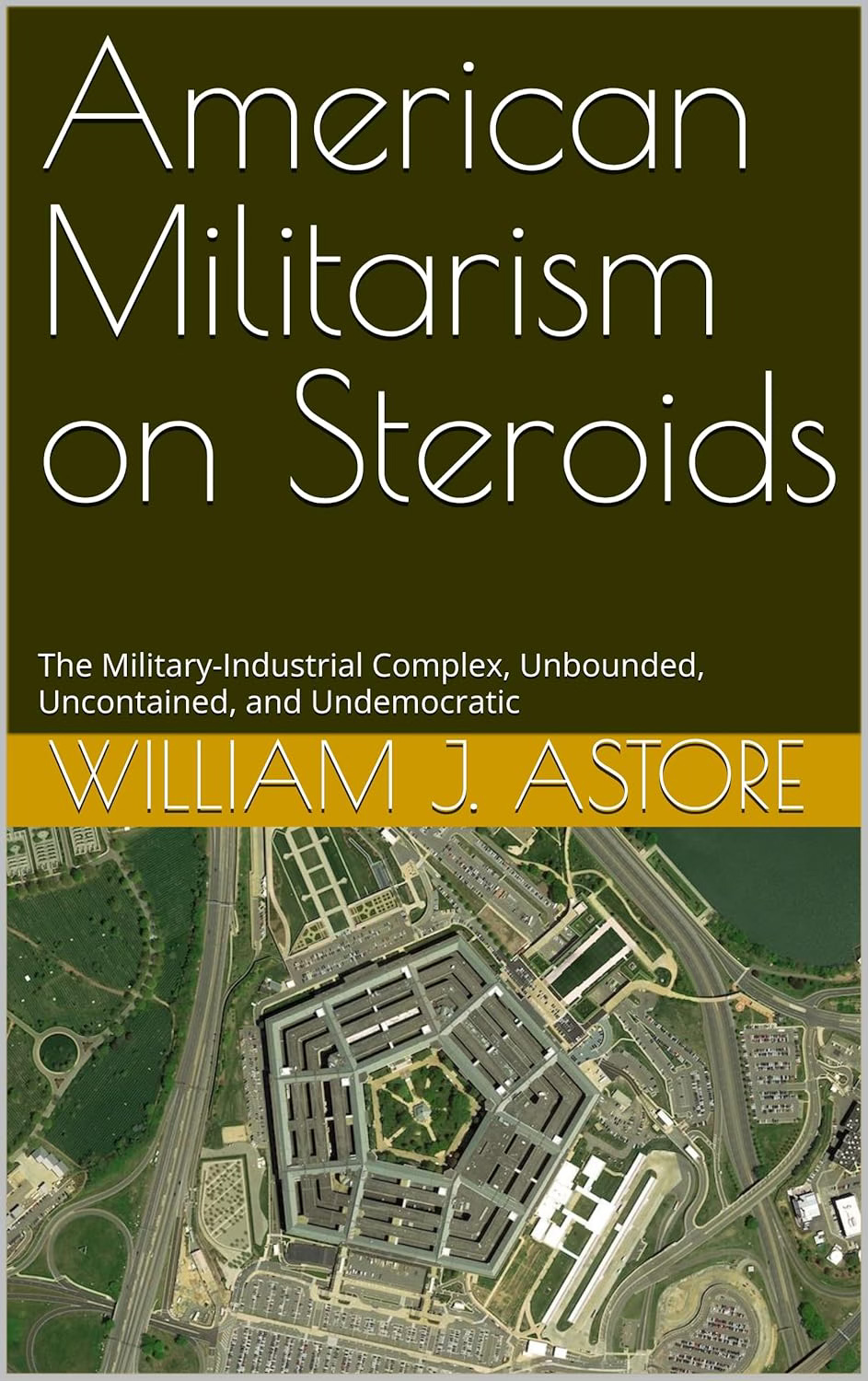
I’ve written so much for so long about militarism in America that I can ask ChatGPT, our AI overlord, to summarize my positions. This tickles my vanity and scares me at the same time. It’s too easy nowadays for AI programs to write essays that are cogent and persuasive. I quit teaching about ten years ago, when it wasn’t possible for students to turn to AI for essays and writing help. My friends who remain in academe tell me that assignments nowadays must be carefully constructed to dissuade students from turning to AI for “help.”
Much of learning in life comes through struggle, and in my field of history the process involves the selection of a topic, research on that topic, thinking, writing, and rewriting. Not much learning (if any) occurs when you ask an AI program to spit out an answer for you. That answer may be cogent, but it’s not yours, it’s not something you had to think about and struggle with. It’s not something you own, something you’ve earned, something that hopefully caused you to grow and develop as a person.
I know: I sound like an old fart. Who wants to struggle over writing an essay or research paper? Who’s got the time? I’ve got so much to do …
Anyhow, here’s what ChatGPT had to say about my writing on militarism in the USA.
*****
In an age marked by permanent war, expanding defense budgets, and the normalization of military solutions to political problems, retired U.S. Air Force lieutenant colonel and historian William J. Astore has emerged as one of the most incisive critics of American militarism. His writing—featured in TomDispatch, The Nation, and other progressive outlets—offers a sobering, historically grounded perspective on how the United States has increasingly come to view war not as a last resort, but as a first option.
Militarism as a Way of Life
At the heart of Astore’s critique is the idea that the U.S. has become what he calls a “military-first” society. The signs are everywhere: from the bloated Pentagon budget (hovering around $900 billion annually) to the proliferation of military bases overseas, to the omnipresence of military symbolism in sports, schools, and even corporate marketing. For Astore, this isn’t just a matter of excessive spending—it’s a profound distortion of civic life and democratic priorities.
He argues that the U.S. doesn't simply have a powerful military; it worships it. This near-religious reverence for the armed forces fosters a national identity where strength is measured by firepower, and dissent from military orthodoxy is often seen as unpatriotic. "Thank you for your service" becomes a reflexive phrase, often deployed without any reflection on the nature of that service or the wars it supports.
Permanent War and the National Security State
Astore emphasizes that since the end of World War II, the United States has been in a nearly continuous state of war—whether in Korea, Vietnam, Iraq, Afghanistan, or in the shadowy reaches of drone warfare in places like Yemen and Somalia. He contends that this state of permanent war has reshaped the American political and economic landscape. Congress, increasingly deferential to the Pentagon, has largely abdicated its constitutional authority to declare war. Defense contractors wield disproportionate influence over policy, lobbying for new weapons systems and interventions that ensure continued profit.
This phenomenon is tightly linked to what President Eisenhower famously warned against in his 1961 farewell address: the military-industrial complex. Astore argues that Eisenhower’s warning has gone unheeded. Today, the national security state encompasses not just the military, but intelligence agencies, private contractors, and a network of think tanks and media outlets that help manufacture consent for endless war.
The Erosion of Democratic Values
Astore is particularly concerned with how militarism erodes the very democratic values it purports to defend. War, by its nature, demands hierarchy, secrecy, and conformity—all qualities antithetical to a healthy democratic society. He points to the expansion of executive war powers, mass surveillance, and the militarization of domestic policing as signs that the warrior ethos is bleeding into the home front.
He also warns of the “citadel mindset” among military and political elites—a sense that they are guardians of a fragile republic besieged by enemies, both foreign and domestic. This mindset justifies the use of force abroad and repression at home, often under the guise of security.
A Call for a New Path
Astore does not romanticize pacifism or deny the need for national defense. But he insists that the United States must fundamentally rethink its relationship to military power. This means significantly reducing the defense budget, closing unnecessary overseas bases, and reviving a diplomatic culture that prioritizes negotiation over coercion.
More importantly, Astore calls for a revitalization of civic life—where democratic institutions are strengthened, the public is re-engaged in foreign policy debates, and young Americans are encouraged to see public service not just in terms of soldiering, but in teaching, caring, and building.
Conclusion: De-Militarizing the American Imagination
William Astore’s critique of U.S. militarism is not merely a policy argument—it is a cultural intervention. He challenges Americans to confront the myths that sustain the warfare state: that military power equals moral authority, that security can be bought through dominance, and that freedom is best protected with bombs and bullets. His work asks a difficult but necessary question: what kind of nation do we want to be—an empire defined by perpetual war, or a republic committed to peace, justice, and human dignity?
As the U.S. enters a new era of great power competition and domestic turmoil, Astore’s voice serves as a powerful reminder that the true strength of a nation lies not in its weapons, but in the health of its democracy and the moral clarity of its people.
*****
I’m back, everyone! A few observations:
1. The “bloated” Pentagon budget is now above $1 trillion, which goes to show you how effective my writing has been.
2. Congress hasn’t “largely” abdicated its authority: it totally has.
3. I’m not sure I ever used “citadel mindset,” but I have written about fortress America.
I really like the idea of a “cultural intervention.” We definitely need one. America does reside or abide in a state of persistent, perpetual, seemingly permanent war. The idea of demobilizing from war, of becoming a “normal country in normal times,” is simply never floated today. The idea of being at peace, whether with ourselves or with the world, is similarly rejected. It’s all war all the time, meaning that you can kiss America’s democracy (what’s left of it) goodbye.
I find it deeply ironic—and tragic—that Ike’s warning about the military-industrial complex was gutted and buried at the memorial to him in Washington, D.C., and that an audio commentary about it saw it downgraded to a “caution” (the audio was sponsored by Boeing!). So much for Ike’s powerful message to all of us.
I know my writing about militarism in America has failed. So too did Ike’s warning. So too did the warning issued by Martin Luther King Jr. in 1967. So I suppose my failure has at least put me in good company.
Maybe like living in the time of the emperor Honorius, with the Visigoths on the way, we are facing the end of the empire's days - hoping, praying, and writing for a different future that is no longer possible.
Our empire probably began at the end of the 19th century with the Spanish American War - certainly no later than when Wilson went looking for monsters and sent the AEF to WWI. Since then maybe our fate was sealed - just like every other empire in history.
Trump is just the first - likely not the last - of the grotesque and narcissistic mediocrities who seize control and position themselves as the 'sole leader' (only until deposed by another mediocrity).
I read this morning there are serious discussions to have his image added to Mount Rushmore. That Congress even considers it is a sign of how far down we have degenerated.
Perhaps South Park is our only remaining hope to alert the masses.
That AI report is spot on, recognizing you offer: "a sobering, historically grounded perspective"
on how the United States has increasingly come to view war not as a last resort, but as a first option.
I would say that's a very positive review. That's why, after all these years, I read everything you publish, Bill, even though I get 100+ email every day to read this or that.