

Following Orders Isn't Enough
The Constitution Must Rule

In 1990, military historian (and friend) Dennis E. Showalter wrote an article on “German Grand Strategy: A Contradiction in Terms?” Noting the general tactical and operational excellence of the German military in both world wars, Showalter reminded us that Germany had also lost both wars, the second in spectacular fashion.
Since the Germans provided the very model for general staff excellence characterized by meticulous planning, what had gone wrong? Why did Germany keep losing the wars it bore the lion’s share of responsibility for starting?
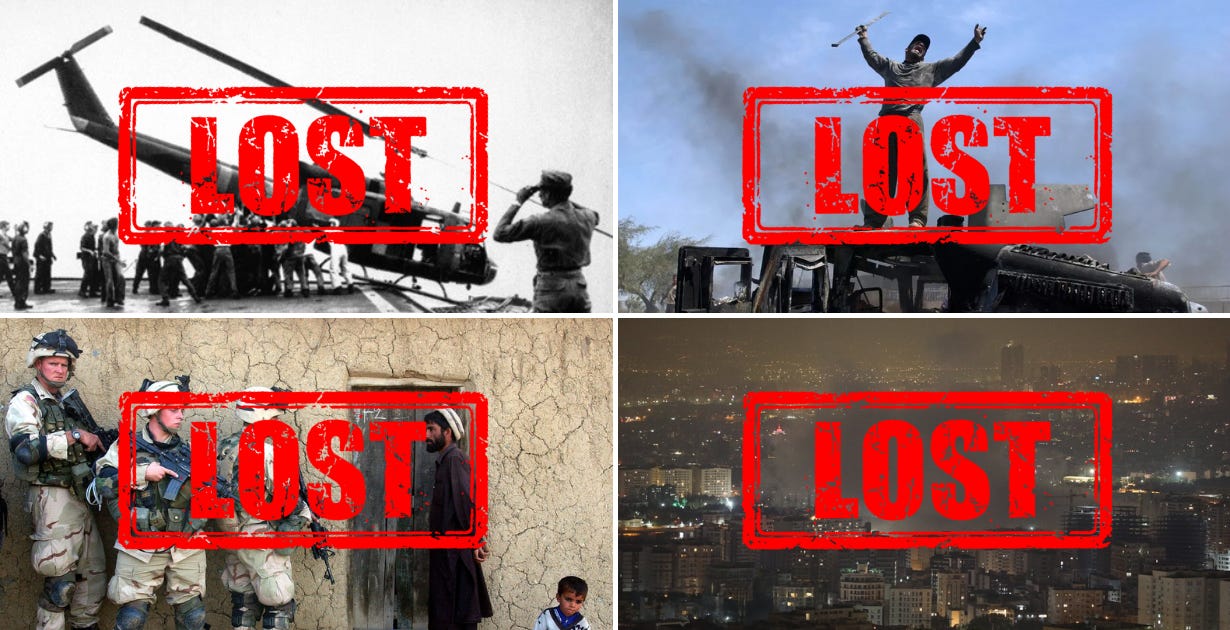
It’s a question that applies to the U.S. military today, celebrated by President Trump for its “unrivaled greatness,” but which nevertheless keeps losing the wars it starts (Vietnam, Iraq, Afghanistan, and the latest joust with Iran). How does “the world’s finest military” keep losing?
Certainly, there’s plenty of blame to go around. Leaders like Kaiser Wilhelm II in World War I or President Trump today were and are more than a liability in providing sound direction and defining sensible and achievable goals. That said, it’s important to assign considerable blame to senior military men as well (even today, they’re almost all men).
Why have they so often gotten it wrong?
Not defining a clear and sensible strategy is a big reason. Tactical and operational excellence is fruitless when applied to unwinnable situations. At the strategic level, if you can’t balance means, ends, and will, indeed if the ends are disconnected from reality and the means inconsistent with the ends, and if you can’t even bother to mobilize national support (perhaps because that support isn’t coming because the war is frivolous or otherwise detrimental to genuine national concerns), victory is unlikely no matter how many bombs you drop or missiles you launch.
That said, I want to highlight a paragraph from Showalter’s article because I believe it has much to say about U.S. military professionals today. See if you agree:
By 1942 at the latest, Germany’s military leaders had abandoned any strategic concept more profound than holding out and hoping for a miracle. They recognized, however subliminally, the profound error they had made in projecting their own concepts of war, peace, and diplomacy onto Adolf Hitler. Rather than take the risks involved in attempting to restore the traditional symbiosis between military and political leadership, the Wehrmacht’s senior officers hid behind a false professionalism. This attitude was enhanced by the function of the marshals’ own complicity in a Third Reich whose criminal nature became daily more apparent. Yet to recognize this fact meant either to act against the regime, or to admit the concepts of honor and service around which one’s life had ostensibly been built were no more than empty words. It was easier by far to take Hitler’s medals and Hitler’s money, and turn the other way.
Firstly, my intent here isn’t to suggest that Donald Trump is like Adolf Hitler or that U.S. military generals and admirals are like Nazi Germany’s field marshals. My intent instead is to point to some intriguing parallels or historical resonances.
First, Trump’s notions of war, peace, and diplomacy are highly idiosyncratic; one moment, he’ll talk of peace, the next he’ll threaten total obliteration. While the U.S. military is fond of the Clausewitzian formulation of war as a continuation of politics, a rational and controllable process, Trump injects chaos and ego aggravated by threats of massive war crimes. (So far, pushback from the military has been limited.) Second, like their German counterparts, the U.S. military professes a belief in duty, honor, country. But if they prove unwilling to uphold that code through action, it becomes little more than words.
More provocatively, is the U.S. military in its highest ranks complicit in a criminal regime that is daily becoming more apparent?
Personal Glory over National Duty
As Showalter suggests, and as history shows, Germany’s senior military men found it easier by far to take Hitler’s medals and money rather than challenging him. In fact, they were often bribed into silence and complicity, being given money, estates, titles, decorations, all the rewards a militarized state like the Third Reich could shower on its martial elite. Perhaps the biggest “bribe” of all was opportunity—the chance to test one’s mettle in combat, fully supported by the state—a state that elevated its military (and thus its most senior leaders) above all else.
America’s most senior military officers are not immune from ambition, whether on active duty or in retirement. Astonishingly, more than eighty percent of four-star generals and admirals choose to work for weapons makers when they retire, a telling illustration of the military-industrial complex that President Dwight D. Eisenhower warned the nation about in 1961. Six-figure military pensions are often augmented by seven-figure board appointments, a revolving door that leads figuratively to a bank vault as these officers cash-in.

This brings me to Trump and his demand for ever-higher Pentagon budgets. While powerful weapons makers like Lockheed Martin and Boeing may be the largest beneficiaries of a proposed $1.5 trillion budget in FY2027, so too are America’s generals and admirals. So much money is being pumped into the U.S. military that almost any compliant general or admiral can envision his or her career dreams coming true. Put bluntly, it’s hard to oppose Trump and his self-styled War Department head, Pete Hegseth when they’re shoveling money and accolades your way.
Again, my point isn’t to argue a moral equivalency between the German Wehrmacht and the U.S. military. Certain institutional drivers may, however, be similar. Germany’s most senior military men had largely lost hope in victory by Stalingrad late in 1942 if not before then, but they nevertheless pursued with great fervor and relentless ruthlessness a war of annihilation, most notably on the Eastern Front against the Soviet Union, until Germany’s catastrophic defeat in 1945. Rather than oppose Hitler, rather than uphold duty and honor, they took their medals and rewards until it all came crashing down, after which they took refuge in the excuse they were just following orders.
What is to be done?
Much like their German counterparts in World War II, senior U.S. military officers today appear to act as if “I was just following orders” is an adequate defense for complicity in war crimes. But surely the Iran War was unconstitutional, illegal, and immoral, surely kidnapping a country’s leader is wrong, surely blowing up boats without knowing who’s on them is a crime, surely Trump’s threats to obliterate various enemies are unhinged, and surely Pete Hegseth’s boasts of killing with no quarter impugn duty and honor as well as international law.
And surely supporting (or looking away from) a genocide in Gaza is morally suspect. Airman Aaron Bushnell immolated himself in 2024 in protest against the U.S. military’s complicity in genocide; his act of self-sacrifice was quickly suppressed, explained away as the tragic act of a misguided religious cultist.
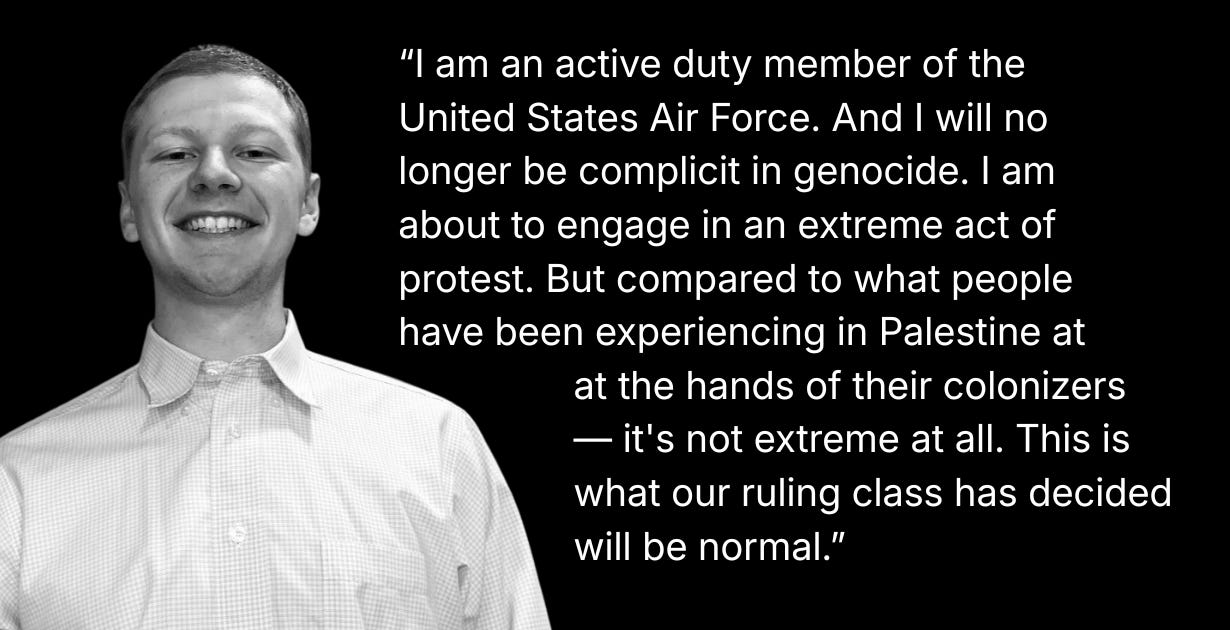
While I don’t expect generals to self-immolate, I hear no concerted critique from them that the nation is on a perilous course, facing a domestic threat to the very Constitution they all swore a solemn oath to support and defend. Instead, I largely see business as usual, with senior leaders rationalizing their obedience in what is in essence a “cover your ass” strategy of ignoring unconstitutional acts—of going along to get along, of cashing-in after retirement by becoming lobbyists, consultants, and board members of a rapidly metastasizing military-industrial complex.
Even exceptions prove the rule. When Admiral Alvin Holsey retired two years early from his position as Commander of U.S. Southern Command in 2025, he refused to state it was in protest against the Trump administration’s deadly and illegal strikes against alleged drug-smuggling boats in the Caribbean. The result is that those strikes have only continued—and expanded.
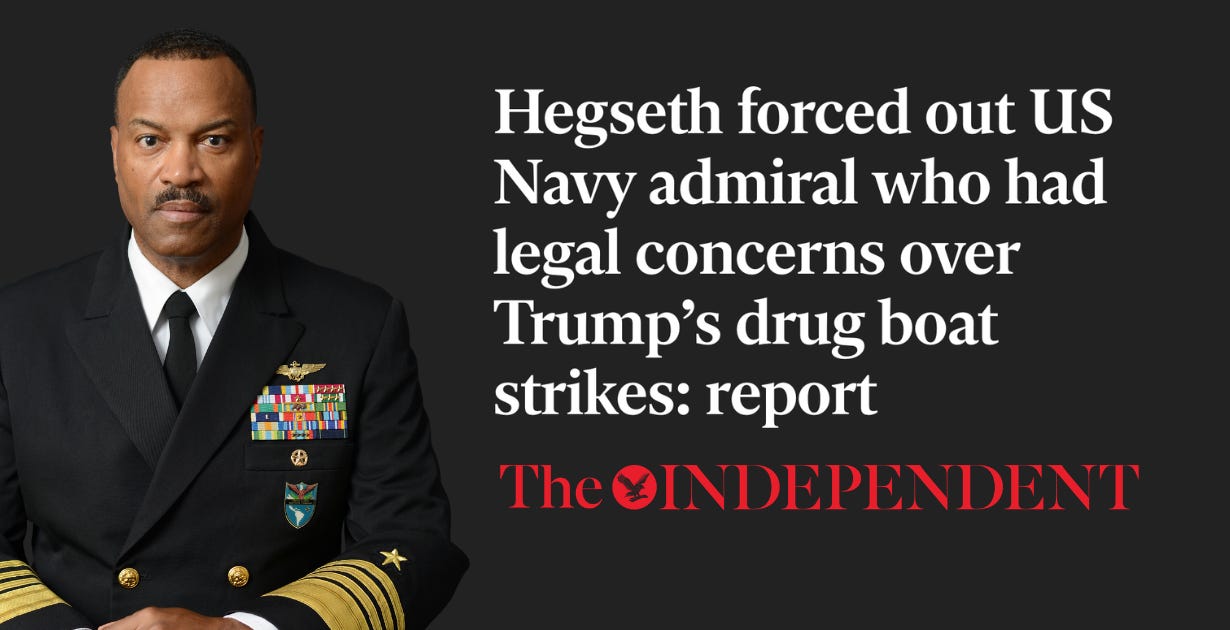
President Trump once fantasized about having the kind of “loyal” generals Hitler had had in World War II. Is that fantasy now largely a reality? If generals and admirals either salute smartly or go quietly, irrespective of Trump and Hegseth’s worst excesses, what hope is there for a military and a strategy that truly serve the U.S. Constitution and the American people?
The Iran War won’t be the last disastrous venture Trump and Hegseth lead this country into. By the time the military brass collectively decides (if ever) to push back against unconstitutional wars and acts, it will likely be far too late to make any difference.
*Article originally posted by the Eisenhower Media Network.
Postscript: My intent here isn’t to suggest a “Seven Days in May” scenario where rogue officers attempt to overthrow a president they judge to be “weak” on defense. Rather, it’s to remind all of us that military officers take an oath to the U.S. Constitution and they are therefore duty-bound to question and even to refuse orders that are unconstitutional or otherwise illegal.
A citizen-soldier is still a citizen; he or she is not an automaton programmed to follow orders of the commander-in-chief irrespective of the illegality of said orders.
The U.S. military must not be allowed to degenerate into warriors and warfighters who blindly follow orders to wage undeclared wars and to kill in ways that violate international law. If that happens, we have not a “band of brothers” but one of berzerkers.
I was thinking about this sort of thing this morning (once known as "the good German syndrome") and recalled that during the workers' strike in the Gdansk shipyard that propelled Lech Walesa onto the international stage, a large part of the strike's success was attributed to the Polish police and military's refusal to fire or inflict violence upon their fellow countrymen. I don't see that sort of restraint among Amerikan police, National Guard, or Army personnel. In fact, the exact opposite appears to be encouraged, whether in the streets of Minneapolis or at the Reflecting Pool. For the life of me, I can't figure out when "just following orders" became an acceptable part of the language.
Thanks for writing this, Bill. In my own observations, those who make Admiral and General are those who are willing to go along with the narrative. Career is put before morals, a thing I saw happen many times. Also, all the recent wars we have been involved in were based on motives whose truth was not shared with the American people, leading to our soldiers and sailors and airmen, etc to suffer high rates of PTSD due to the things they did for all the wrong reasons. I am not criticizing the lower ranks, as they find themselves between a rock and hard place. I highly recommend Seth Harp's (he is a Veteran) book The Fort Bragg Cartel. The corruption runs so deep.