

Hitler As a Nullity
A Fascinating Interview with Orson Welles

I stumbled across (more accurately, the algorithm fed me) this interview between Dick Cavett and Orson Welles. It’s well worth watching until the end.
It’s fascinating to learn that Welles once sat next to Adolf Hitler and found him completely forgettable. A nullity. Unremarkable except for a void that surrounded him.
Other accounts I’ve read about Hitler have highlighted the banality of his views, his pedestrian nature. We know, for example, he was a mediocre painter. He liked westerns and sappy sentimental films. He liked dogs as well. And he liked big things: buildings, weapons, schemes. Welles has a point that there was nothing that extraordinary about Hitler, at least at first glance.
Hitler came alive in front of crowds. For some people, he also had a dark form of charisma, a certain magnetism, that inspired likeminded cranks and power-hungry toadies to gather in his orbit. Hitler was a sort of dark star or black hole to some; they found it difficult to escape his gravitational pull (assuming they wanted to escape).
In the above interview, Welles goes on to tell memorable stories about George C. Marshall and Winston Churchill. Welles was especially taken by Marshall and his gallantry and generosity, not words that one would ever apply to Hitler.
Book shelves groan with tomes written about Hitler. I’ve read many myself. It’s often been asked how the country of Goethe and Schiller could have unified behind a leader as vulgar and as dangerous as Hitler. A non-entity. A nullity.
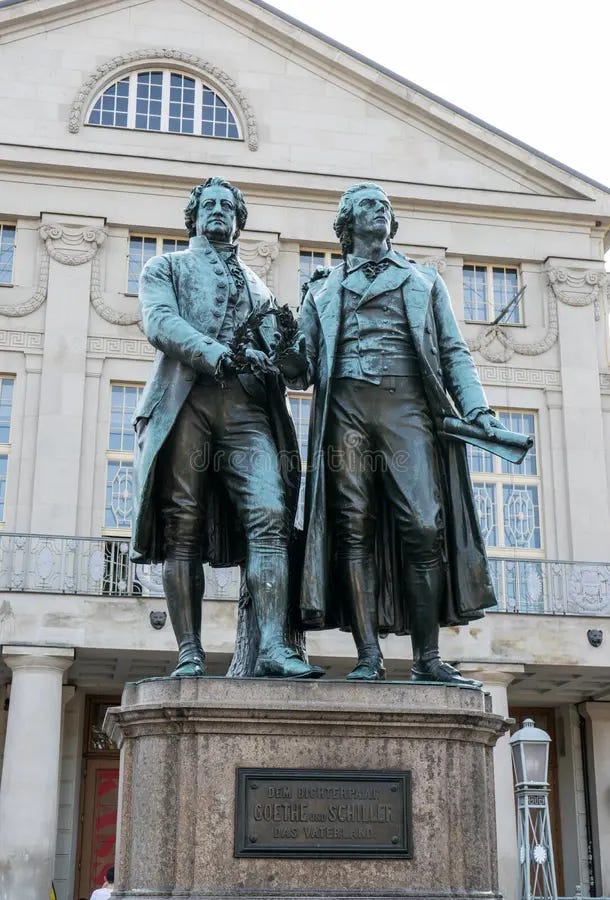
It’s a question that has partial answers, but I don’t know if there’s anything like a definitive one. What is definitive is that Hitler remains a warning from history. We haven’t seen the end of wannabe dictators with grandiose schemes surrounded by cranks and toadies.
Recently I’ve taken out some of the videos from the 1970s series “World at War” from the BBC, narrated by Laurence Olivier. Exceptional. I continue to be amazed at the idolatry accorded Hitler such as at the Nuremberg rallies. Tens of thousands of Germans overfilling the stadium, eyes fixed upon him on the dias, anxiously waiting for him to speak, roaring, Sieg heil!-ing in approval at his ranting, his magniloquence. Further, it’s my understanding he never prepared his remarks, always spoke extemporaneously, intentionally kept the crowd waiting, doing all the things they teach you not to do in junior high school in speaking before the public, yet somehow he mesmerized the crowd. Joseph Campbell in the series done with Bill Moyers noted this, and either he or an acquaintance who was there said it was all he could do to keep from raising his hand in salute so exhilarating, so consuming was the emotion. And all this before the most educated, cultured society of Europe. Far beyond my comprehension.
Of course Hitler worship, Nazi sentiment still exists in Germany, and elsewhere, including this country. How it intersects with Trump worship is anyone’s guess, but likely significant. Where do these characters come from? Chris Hedges offered up an explanation a couple of years ago here https://chrishedges.substack.com/p/q-and-a-w-chris-hedges-what-im-doing where he says:
"So this is the great poison of neoliberalism is that it vomits up all of these figures, Trump, Orban, and others. There's a kind of continuity to Le Pen in France and everywhere else, the far right in Germany, because the system seizes up. The institutions that once allowed for democratic participation essentially are converted into funnels to further enrich the power of a tiny oligarchic, corporate elite, and in frustration, people turn to these demagogues. I saw the same thing in Yugoslavia with Radovan Karadžić, Slobodan Milošević, Franjo Tuđman, and others. That's what happens. That fascism is the result of a failed liberalism. I can't remember who said that, I think it may have been Fritz Stern, and we live in a failed liberal, democratic liberalism, and we're not immune to these forces."
[Parenthetical observation. “The Dick Cavett Show,” one of the last times intelligent conversation could be found on broadcast television. I’m old enough to remember “The Jack Paar Show” of similar quality; the “Tonight Show with Steve Allen,” an individual of tremendous talent, humor, and intellectual curiosity, as shown with the guests he had on, the discussions held with them; “CBS Reports with Edward R. Murrow”; Leonard Bernstein’s series “A Young Person’s Guide to the Orchestra”; live broadcasts of drama such as “Death of a Salesman” on CBS’ “Studio 41; Woody Allen, substituting for Johnny Carson, and actually not being funny, but engaging in serious, meaningful discussion with guests; and more recently, though still far distant, “Bill Moyers’ Journal” and “World of Ideas.” Now nothing like that. Capitalism has taken over the public space of the airwaves, inundating us with news as entertainment, entertainment as news. Back in that “golden age,” television (and radio) bore at least some relationship to the charter of the BBC, “to inform, to educate, to entertain.” Now it’s to sell, whether a product, a service, a politician, and ideology. Upon this a democracy is to stand?]
Perhaps when an already nationalistic atmosphere prevails in a country and it is defeated militarily, then humiliated and broken economically and psychologically, it is easier for a so-called leader to play to their need to be "superior" and not inferior as is indicated by their economic and military situation. I think Hitler was credited with doing some good in attempts to restore the economy.
The Allies can take some responsibility for the Hitler phenomenon.
I selectively pilfered the following from AI:
World War I was primarily caused by a complex interplay of nationalism, militarism, alliances, and imperialism, with the assassination of Archduke Franz Ferdinand serving as the immediate trigger. Following the war, Germany was required to pay reparations due to the Treaty of Versailles, which held it responsible for the conflict, leading to significant economic and political consequences in the country.
What were the economic impacts of German reparations after World War I?
The economic impacts of German reparations after World War I included severe hyperinflation and economic instability, particularly during the early 1920s, which undermined the Weimar Republic and contributed to social unrest. Additionally, the burden of reparations led to a significant decline in industrial production and overall economic hardship in Germany.