

Mercy, Forgiveness, Peace
They're Not Just Church Words

In Trump’s America, a lot of words have gone out of style. Words like compassion, generosity, forgiveness, grace, mercy, and especially peace. “Punch ‘em when they’re down” Hegseth symbolizes the fake-tough-guy attitude of Trump and crew. Combat footage from Iran showing equipment and buildings being obliterated by U.S. missiles is all the rage on the mainstream media. Indeed, gunsight footage of exploding buildings is perhaps a fitting symbol of the Trump administration’s rage. That, and the shootings of “domestic terrorists” like Renee Good and Alex Pretti.
It’s been awhile since I’ve been to a Catholic service, but at least in church I hear sentiments like mercy, grace, and peace being celebrated.
Which brings me to this post I wrote on mercy. I wrote it eight years ago, and it seems like it needs to be repeated and amplified in America’s age of “warrior ethos” and unending military conflict.
On Mercy

W.J. Astore
Mercy has been on my mind since re-watching “The Lord of the Rings” trilogy. There’s a nasty little character known as Gollum. Before he was seduced by Sauron’s ring (the one ring of power), Gollum was known as Smeagol. Twisted and consumed by the Dark Lord’s ring, Smeagol becomes a shadow of himself, eventually forgetting his real name and becoming Gollum, a name related to the guttural coughs and sounds he makes.
Gollum loses the Ring to Bilbo Baggins, a Hobbit of the Shire. The Ring extends Bilbo’s life but also begins to twist him as well. As Sauron returns to power in Mordor, he needs only to regain the Ring to defeat the combined might of the peoples of Middle Earth. Bilbo passes the Ring to his much younger cousin, Frodo, who together with a Fellowship consisting of representatives drawn from men, elves, dwarfs, and hobbits as well as the wizard Gandalf, journeys to Mordor to destroy the Ring and vanquish Sauron.
Early in his journey to Mordor, Frodo says he wishes Bilbo had killed Gollum when he’d had the opportunity. (Gollum, drawn by the Ring, is shadowing the Fellowship on its journey.) Gandalf sagely advises Frodo that Gollum may yet play an important role, and that mercy is not a quality to disparage. As the Fellowship is separated and Frodo has to journey to Mordor with only his faithful friend Sam beside him, Gollum soon becomes their indispensable guide, and Frodo begins to pity him. Frodo, by showing Gollum mercy, reawakens the good within him, calling him Smeagol and preventing Sam from hurting him.
But the corrupting power of the Ring overtakes Smeagol again, and Gollum reemerges. Even so, without Gollum’s help, Frodo and Sam would never have made it to Mordor and the fires of Mount Doom. On the brink of destroying the Ring, Frodo too becomes consumed by its power, choosing to use it instead of casting it into the fire. Here again, Gollum emerges as an instrumental character. He fights Frodo for the Ring, gains it, but loses his footing and falls into the fires of Mount Doom, destroying himself as well as the Ring and saving Middle Earth.
It was Bilbo and Frodo’s mercy that spared the life of Gollum, setting the stage for Gollum’s actions that ultimately save Frodo and the rest of Middle Earth from Sauron’s dominance. Without Gollum’s help, Frodo and Sam would never have made it to Mount Doom; or, if by some miracle they had, Frodo in donning the Ring would have been ensnared by Sauron’s power and executed by him. If Frodo is the hero of the tale, Gollum is the anti-hero, as indispensable to Middle Earth’s salvation as Frodo and the Fellowship.
Another story about the role of mercy came in one of my favorite “Star Trek” episodes, “Arena.” In this episode, Captain Kirk has to fight a duel with an enemy captain of a lizard-like species known as the Gorn. It’s supposed to be a fight to the death, overseen by a much superior species known as the Metrons. When Kirk succeeds in besting the Gorn captain, however, he refuses to kill the Gorn, saying that perhaps the Gorn had a legitimate reason for attacking a Federation outpost. A Metron spokesperson appears and is impressed by Kirk, saying that he has demonstrated the advanced trait of mercy, something the Metrons hardly suspected “savage” humans were capable of showing.
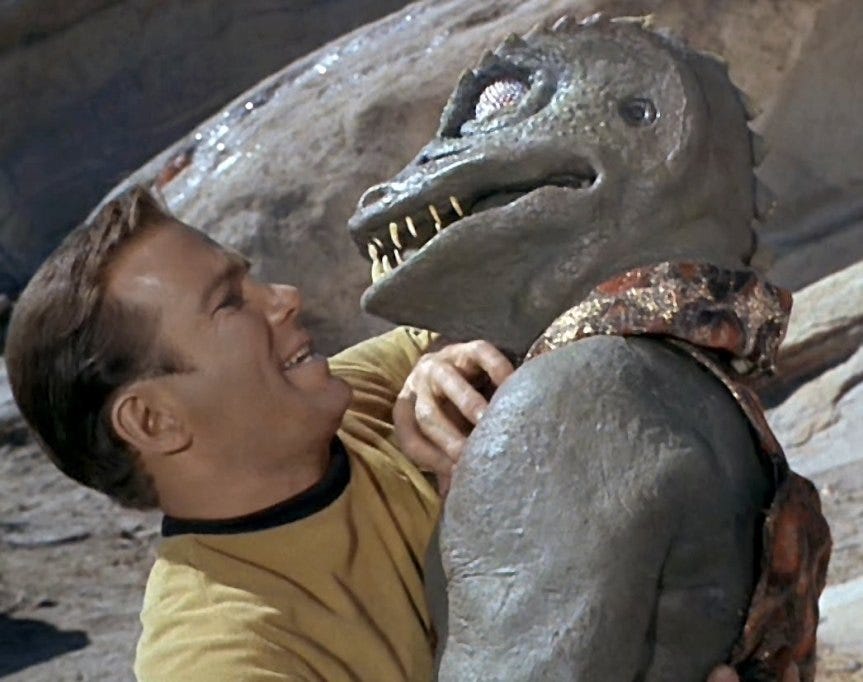
Perhaps war between the Federation and the Gorn is not inevitable, this episode suggests. Diplomacy may yet resolve a territorial dispute without more blood being shed, all because Kirk had the courage to show mercy to his opponent: an opponent who wouldn’t have shown mercy to him if their fates had been reversed.
Mercy, nowadays, is not in vogue in the USA. America’s enemies must always be smited, preferably killed, in the name of righteous vengeance. Only weak people show mercy, or so our national narrative appears to suggest. But recall the saying that in insisting on an eye for an eye, soon we’ll all be blind.
The desire for murderous vengeance is making us blind. The cycle of violence continues with no end in sight. Savagery begets more savagery. It’s as if we’ve put on Sauron’s ring and become consumed by it.
Do we have the courage of Bilbo and Frodo Baggins, and even of that man of action, Captain Kirk? Can our toughness be informed by and infused with mercy?
Societies pass on values through their art and literature (and in the modern era the visual arts of movies and television). LOTR was written by Tolkien who survived WWI and saw many of his friends killed. Roddenberry was a B17 pilot in the Pacific during WWII. and lost some of his crew in a failed takeoff. Both saw the horrors of war and found some redemption (and one hopes peace) in their works of art.
Their works inspired many of us with the values of courage, friendship, mercy, and sacrifice. (One other Star Trek episode that I believe is one of the series' best is "Balance of Terror" - which deals with racism, respect for one's enemies, and mercy.)
And no, they're not just church words - but that's one of the few places one hears them now (and certainly not all - with some "Christian" churches preaching the new Crusade). The values seem to be "maximum lethality" and "no mercy" for our enemies, because killing them is "fun".
Mercy is so needed, especially in the conduct of war (odd as that may sound). This post is especially appropriate after watch the antics of Hegseth yesterday during Trump's interview--what an idiot and callous beyond belief.