

Networks Still Using Retired Generals to Sell War
Serious Conflicts of Interest for America's War Salesmen and Cheerleaders

Back in 2008, I wrote an article for Neiman Watchdog calling for war salesmen and cheerleaders on the mainstream media to be replaced. Of course, nothing of the sort happened, and today I saw a new article by Ken Klippenstein: “The TV Generals Have Something to Sell You About Iran,” and that something is war and more war (and weapons too).
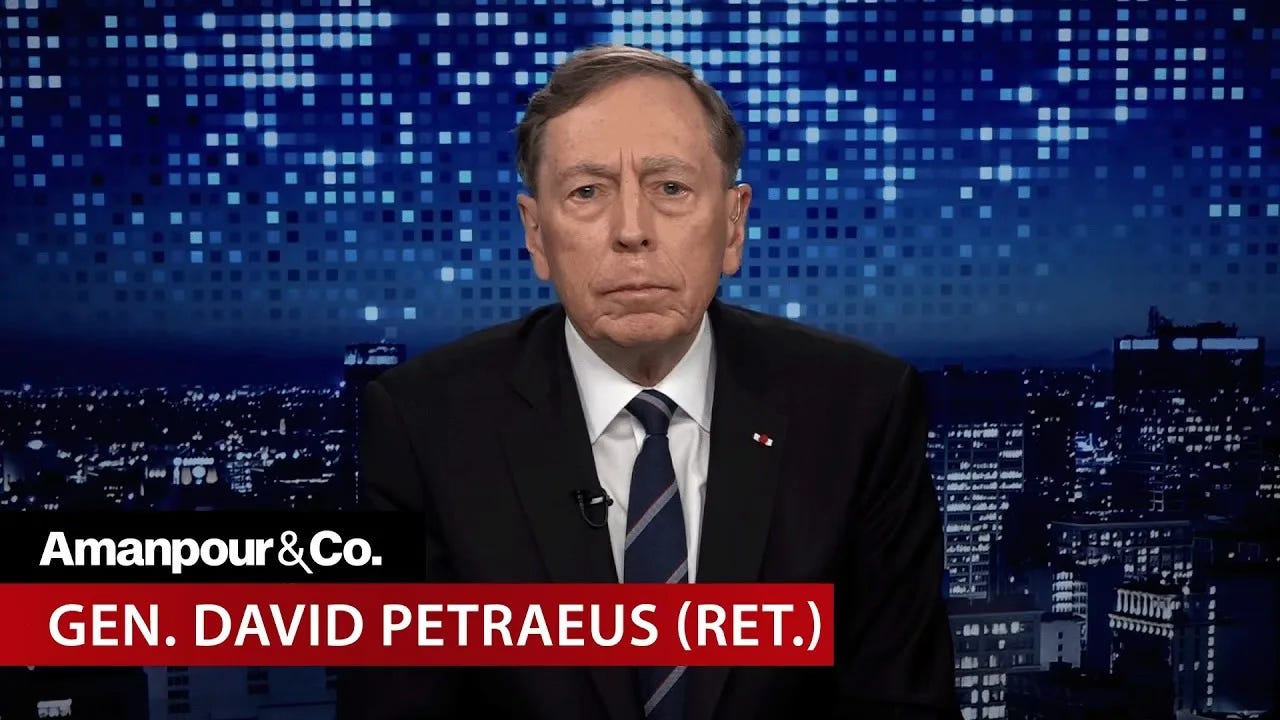
In the article, Klippenstein has a great line about retired general David Petraeus: “Can anyone fit more stars up their asses?” Clearly not.
Anyhow, here’s my article from 2008, unchanged because the dynamic of TV and cable networks using retired senior military officers to sell wars and weapons also remains unchanged.
Networks should replace Pentagon cheerleaders with independent military analysts
COMMENTARY| December 04, 2008
Even without special Pentagon briefings and corrupting financial relationships, former top military brass simply are too conflicted to be relied upon for tough-minded analysis, writes a former Air Force officer.
By William J. Astore
Media outlets must develop their own, independent, military analysts, ones not beholden to the military-industrial complex, ones whose very sense of self is not defined, nourished, and sustained by the U.S. military.
In separate exposés in The New York Times (April 20 and November 30), David Barstow showed how major media outlets came to rely on retired generals like Barry McCaffrey for analysis. Predictably, many of these men (they were all men) continued as paid advisors to defense contractors even as they appeared on TV. They also often accepted favors from the Pentagon, to include special, often classified, briefings; overseas junkets; and, most valuable of all, access to the Office of the Secretary of Defense.
But such influence-peddling and collusion are hardly surprising. Relying on high-ranking, retired military officers to serve as frank and disinterested critics is a bit like inviting Paul von Hindenburg, ex-Field Marshal of the German Army, to testify in 1919 on why his army lost World War I. You’ll get some interesting testimony -- just don’t expect it to be critical or for that matter even true.
So why did the networks hire so many retired colonels and generals? Perhaps they followed a rationale analogous to that used in hiring retired professional athletes to cover sports -- to provide hard-earned, technical commentary, leavened with occasional anecdotes.
But in the “forever war” in which we became engaged, these retired military officers soon provided not just the color commentary but the play-by-play. And network anchors, lacking first-hand military experience, were reduced to bobble-heads, nodding in respectful agreement.
But war is not a sport. Nor should we cover it as such. We need tough-minded military analysts, not “Team America” boosters and Pentagon spin-meisters.
Why Relying on Senior Military Officers Is Wrongheaded
Our media’s concept of relying on retired senior colonels and generals for frank and unbiased analysis was deeply flawed from the beginning. Let’s consider five facets to the problem:
Despite their civilian coat-and-tie camouflage, these officers are not ex-generals and ex-colonels: they are retired generals and colonels. They still carry their rank; they still wear the uniform at military functions; they’re still deferentially called “sir” by the rank-and-file. They enjoy constant reminders of their privileged military status. It’s not that these men over-identify with the U.S. military -- they are the military.
The senior colonels and generals I’ve known despise Monday-morning quarterbacks. Loath to criticize commanders in the field, they tend to defer to the commander-in-chief. Putting on mufti doesn’t change this mindset. Rather than airing their most critical thoughts, they tend to keep them private, especially in cases where service loyalty is perceived to be involved.
Military officers are especially averse to airing criticism if they perceive it might undermine troop morale in the field. Related to this is the belief that “negative” media criticism led to America’s defeat in Vietnam, the hoary but nevertheless powerful “stab-in-the-back” myth. Thus, these men see Pentagon boosterism as a service to the nation -- one that they believe is desperately needed to redress the balance of negatively-charged, “liberal,” anti-war coverage.
Paradoxically, that the “War on Terror” has gone badly is a reason why some retired military officers believe we can’tafford serious criticism. If you believe the war can and must be won, as most of them do, you may suppress your own doubts, fearing that, if you air them, you’ll be responsible for tipping the balance in favor of the enemy.
The fifth, perhaps most telling, reason why networks should not rely on retired colonels and generals is that it’s extremely difficult for anyone, let alone a die-hard military man, to criticize our military because such criticism is taken so personally by so many Americans. When you criticize the military, even abstractly, people hear you attacking Johnny or Suzy -- their son or daughter, or the boy or girl next door, who selflessly enlisted to defend America. Who wants to hear that Johnny or Suzy may possibly be fighting (even dying) for a mistake? And, assuming he believed it, what senior military man wants to appear on TV to pass along that message to America’s mothers and fathers?
The Next Step
It’s not that retired colonels and generals lack integrity [well, some do, I’d add in 2026], but they are often deeply conflicted and lacking in self-awareness. And you certainly can’t profess to be an objective media analyst while representing contractors vying for funding from the Pentagon.
So what should the media do? Since it will take time for networks to develop their own corps of independent military analysts, they should consider hiring junior officers and NCOs, with recent combat experience, who have left the military after a few years of honorable service. Civilian military historians could also provide critical commentary. Even foreign military officers might be queried; at least they need not worry about their patriotism being impugned each time they hazard a criticism of the Pentagon.
French premier Georges Clemenceau famously noted that “War is too important to be left to generals.” So too is the TV and cable networks’ analysis of our wars.
*****
Quick comment in 2026: I wasn’t critical enough in 2008. Some of these “cheerleaders” are shameless sales- and pitchmen who are profiting from war.
Hey Bill, just like Operation Mockingbird back in the day, current US "newsrooms" are really just State Dept./CIA spokespersons. It has nothing to do with informing the public. It hasn't for a long, long time. Some people would say that it is really just the same as William Randolph Hearst's newspapers over a century ago, where war propaganda graced every headline. The core issue is that rich people have very different priorities than the general public, and they also happen to own the news outlets. They team up with the deep state to cheerlead every military action, every sanction, every regime change operation that comes along. Unfortunately, people still go to the Corporate-Owned-News for their mis-information, and here we are.
Perhaps the old Army refrain cited by MacArthur should be amended, "old soldiers never die, they just fade away - except for generals, who go on to careers as expert commentators".
Too bad chyrons are never displayed on screen when these so-called "experts" are speaking that acts as 'community notes". For example, for Petraeus it might say - "resigned in disgrace after he released classified information" or "success of Iraqi 'surge' came by buying off tribal leaders'.
Maybe a new statute is needed for flag officers - prohibition from any role as news commentator, board member, or other compensated position (except maybe in education) for ten years. They could spend their time visiting VA hospitals and military cemeteries to encounter all those who suffered under them through their brilliant careers.