

What Does "Student-Centered" Learning Really Mean?
Overhyping technology in education

Back in 2011, I wrote the following article on “student-centered” learning for Huffington Post. I was still teaching history back then, and in fact had 15+ years’ experience both as a professor and as an academic administrator (and of course twelve years in high school and nine years in college/university).
A captivating, exciting, and effective learning environment begins with knowledgable and passionate teachers working with inquisitive and prepared students. If teachers and students are backed up by concerned parents and skilled administrators, all the better.
Over the last thirty years or so, and especially since personal computers and smart phones have become commonplace, technology in the classroom has come to be seen as a panacea for everything that ails education. One wonders how long it will be before AI “teachers” replace flesh and blood humans as mentors for our youth. AI bots for everyone!
Anyhow, here’s my article, unchanged from 2011:
What Does "Student-Centered" Learning Really Mean?
By William Astore, Contributor
Writer, History Professor, Retired Lieutenant Colonel (USAF)
Sep 4, 2011
As a society, we talk about the importance of leaders in all walks of life, but when it comes to our classrooms, many of us seem to want to empower the followers while executing the sages when the former do poorly on standardized tests.
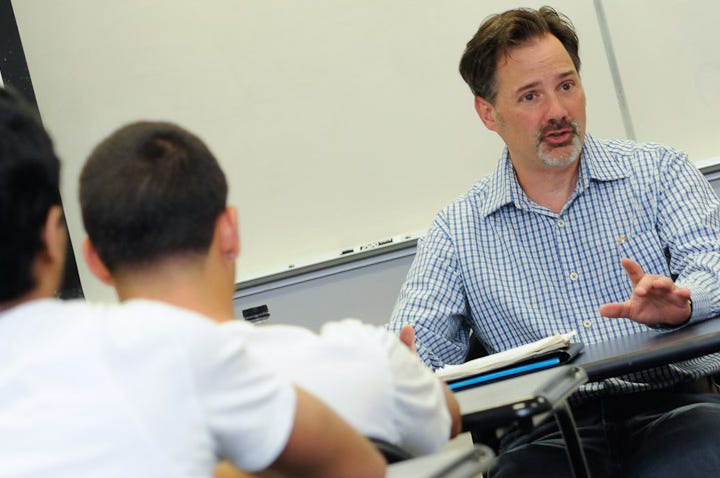
Nowadays, a teacher or professor is not supposed to be "a sage on the stage." He or she is expected to stimulate and captivate already over-stimulated students with collaborative classroom exercises, enthralling videos, and state-of-the-art computers and Internet-ready "SMART" boards (much more expensive than chalk- or white-boards, and requiring expensive maintenance and periodic software and hardware updates). A busy and stimulated student is a learning student and a happy customer to boot, and so are his or her parents, who can marvel at all the computer screens and interactive chattering (both of mouths and of keyboards).
Yet how much real learning is going on in this "student-centered" digital environment?
I grew up without computers in the classroom, when teachers and professors embraced the role of being the sage on the stage, and I can't say my education suffered as a result. A recent study that appeared in today's New York Times suggests that computers and "digital" classrooms have nearly negligible impact on student test results, which is not to condemn computers but rather to suggest they are merely one (over-hyped) tool for acquiring and displaying information. PowerPoint slides are often not much better than old-fashioned overheads or slide projectors; DVDs and streaming videos are often not much better than old-fashioned film projectors.
The key ingredient to learning (besides motivated students and involved parents) is of course a well-informed, caring, creative, and dedicated teacher or professor. Such a teacher or professor puts her students first not by assigning busywork in the classroom or by embracing fancy and expensive gizmos but by the power of her personality and her commitment to stimulating critical, creative, and ethical thinking.
In its essentials, great education hasn't changed much since the days of Socrates. It's ultimately about shaping and informing the character of students. It's not only about teaching them the how of things, but the why. And once they know the why, they can make decisions based on ethics, based on some knowledge of what's right and wrong, within educational and social settings that put integrity and fairness first.
Good educators recognize that teaching is more art than science; more of a calling than a profession. And that true "collaboration" is achieved not among students working together or with computers, but among students and teachers (and parents) working together, with teachers serving as mentors and role models, guided by a vision of education as a stimulus to individual and social betterment.
So what does student-centered learning really mean? It's about avoiding the idea of students as "customers," with the concomitant notion that the customer is always right. It's about avoiding the notion that a magic bullet exists (such as digital classrooms) to educational success. It's really about putting the most talented leaders in front of our students, and empowering them to stimulate the intellectual and especially the moral growth of students.
If you wanted your son or daughter truly to learn, would you put your trust in faster computers in networked classrooms, more "student-centered" classroom activities with his or her peers, or a Socrates to prod him or her to ask fundamental questions about a life worth living?
Sadly, we seem today to prefer computers and customer-centered learning as measured by test score results. And what of our modern-day Socrates? After parental complaints about "unsettling" questioning of students and subpar standardized test scores, our elected leaders once again made him drink hemlock.
Professor Astore writes regularly for TomDispatch.com and can be reached at wjastore@gmail.com.
Interesting reading, Bill. You definitely had a grasp of the teaching profession. I love the following statement: " true "collaboration" is achieved not among students working together or with computers, but among students and teachers (and parents) working together, with teachers serving as mentors and role models, guided by a vision of education as a stimulus to individual and social betterment." Every teacher I can remember was a role model, a mentor who stimulated me to learn.
In my opinion our society fails to value teachers. This is reflected in the lack of pay and required credentials in the teaching field (specifically, K-12). I feel that the teaching profession has been relegated to group day care provider. I also think the notion that higher education needs to emphasize employment is extremely problematic. That line of thinking prevents students from attaining a "Renaissance" view or fuller understanding of the world's magic. That is, the social, historic, civic, communication, and artistic classes and experiences are greatly diminished and with it go the student's potential interest and understanding of the world.
I spent the last 25 years of my working life in higher education IT—from Technician to CIO with the last 10 as a consultant working with quite a few colleges and universities. Of course, the 1990’s and early 2000’s saw tremendous changes and adaptations of technology both academically and administratively. It was rather enjoyable when it was about enabling with enthusiastic early adopters eager to put it to some good use.
I’m pleased to honor one such example—a video based distance learning program that offered a new State required Master’s program for speech pathology. Our university provided it through eight sites across Texas, and witnessing students, who completed the program, actually cry when they received their degrees was very moving. Such video links were not the most dependable in those early days, so it took commitment from faculty and students to stick with it.
I also saw too many deans and chairs apply for technology grants with no clear goal to improving student centered learning. Oh, they used the term, but like too many in the academies it was a necessary keyword for the grant application and bore no resemblance to reality in practice. And there was little difference between academic departments and administrative offices.
I was asked by a university president to review the business processes of the admissions department who was forever blaming the administrative software system for their backlog and to see why it “wasn’t working for them.” They had only had one small problem. Transcripts came in, where thrown in a stack by full-time staff while they waited on their student workers to enter them into the system. No one actually bothered to make sure these were getting done. What a shock when students continually called and no one could give them the status of their application. Just as egregious was the “software problem” at a community college who just kept approving student loans. Many students had $60,000 debt and still no degree. At a community college!
I could write a book’s worth. It is certainly true that like most technology, we enter blindly and never do a true accounting.