

Killing Civilians
Atrocity Is All Too Common, Within and Outside of War

Readers: Ongoing atrocities in Gaza committed by Israeli troops made me recall this book review that I wrote in 2008. I hope it sheds light on a difficult and dark subject.
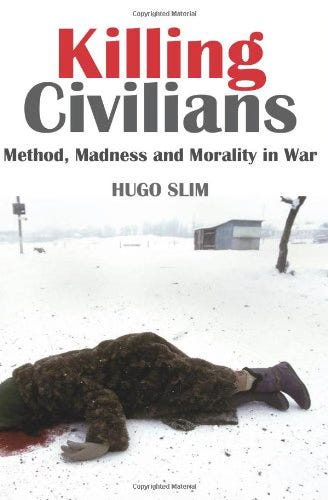
Review of Hugo Slim, Killing Civilians: Method, Madness, and Morality in War. New York: Columbia University Press, 2008. Pp. viii. 319. ISBN 978-0-231-70036-8.
To military planners or to professional soldiers on campaign, civilians are often an afterthought or a nuisance. They are “internally displaced” refugees who get in the way and consume energy and resources; they are unfortunates who live too close to enemy strongholds and who thus complicate efforts to kill the enemy while minimizing “collateral damage.” Indeed, the military’s unease and even impatience with civilians is captured by these and similar euphemistic categories.
Due to their vulnerability, civilians, not professional soldiers, usually suffer the most from war. They are, in fact, “the forgotten victim” of war.[i] Take today’s war and occupation in Iraq. Whereas the U.S. military has lost about four thousand troops killed, the war and its resulting social and political chaos has led to the deaths of about one hundred thousand Iraqis (some estimates of Iraqi deaths related to the war are higher by a factor of five or ten). The wide variance in estimates for Iraqi civilian deaths is in itself indicative of the physical and moral messiness of modern wars (as well as the politicized agendas of the estimators). That, and the fact that militaries are naturally more assiduous in counting and commemorating their own dead than they are accounting for civilians caught in the crossfire of combat.
Hugo Slim’s discerning and accessible study, Killing Civilians, looks at wars where the killing of civilians is an unintentional and unfortunate byproduct of conflict. But his chief focus is on conflicts where the killing of civilians is part of the very essence of the fighting. He first discusses philosophies of war, contrasting limited versus limitless wars as well as “no war” philosophies (pacifism). He usefully defines limited war as “an ideology of restraint and protection that is respectful of as much human life as possible.”(23) Here he asserts that “the moral importance of winning” a necessary war “can excuse the killing and hurting of civilians if all possible precautions to protect them were taken and if safer ways of fighting were explored but found wanting.”(22)
Next, Slim details the “seven spheres of civilian suffering” in war, including genocide, massacre, torture, and mass rape and sexual violence; and involuntary movement, impoverishment, famine, disease, and emotional distress. His accounts are informed by historical examples as well as his own experiences working in humanitarian relief efforts in West and Central Africa. He reminds us that civilians often suffer long after wars are over, whether from psychological issues such as post-traumatic stress disorder (PTSD) or from the detritus of war such as unexploded munitions and mines.
Most civilians, Slim notes, “die from war rather than in battle”—with loss of identity and livelihood ultimately proving more deadly in the aggregate than bullets and bombs.(91) His emphasis on loss of identity is especially telling. In war, Slim notes, people “lose themselves. Socially and personally, they are no longer the people they were …. If destitution, personal injury or rape has humiliated them and brought them very low, they may have lost that essential dignity and self-esteem which was the anchor of their sense of self and gave them the confidence with which to take their place in the world.”(109-110) They have become strangers to themselves, and estranged as well from traditional communal networks of support.
After describing civilian pain and suffering, Slim turns to why militaries either kill civilians purposefully, or kill them almost in a fit of absentmindedness. A key concept for Slim is ambiguity—the uncertain and culturally contingent nature of the term “civilian.” Obviously, if a warring militia considers all people, armed or unarmed, male or female, old or young, as in some sense “the enemy” or as a resource to be exploited, there is little reason for this militia to extend mercy or compassion to “innocents” because they literally see none.
After devoting a full chapter to the ambiguity of “civilian” as a special category in war, Slim turns to the ways in which soldiers are recruited and trained to kill, even when those to be killed are unarmed women and children. His analysis here is informed by works such as Christopher Browning’s account of Nazi Einsatzgruppen in Poland and the USSR (Ordinary Men) and Barbara Ehrenreich’s reflections on the human propensity for war and killing (Blood Rites). Slim concludes his study with a chapter that calls for a strengthening of our collective sense of responsibility for protecting civilians from the horrors of war.
Slim ultimately calls for a reinvigorated idea of limited war (assuming conflict to be unavoidable), one where the protection of innocent civilians is the top priority. Seeking to change the mindset of militaries, he asks us to think of civilians not in impersonal or categorical terms (as enemy non-combatants or as refugees, for example) but as individuals. That old lady could be your grandmother; that young girl could be your baby sister. Such an approach, he argues, is far more capable of generating compassion and tolerance—and of limiting violence to those possessing the means, wherewithal, and intent to resist.
Slim well recognizes that thinking in such personal and empathetic terms poses a major challenge to militaries operating under stress and often in culturally foreign lands. Far easier it is to kill a person without a name, without a family, without a shared sense of humanity. Can the bonds of affection linking a warrior “band of brothers” truly be extended to include unfamiliar civilians in a hostile or alien environment? Slim does not quite answer this question, but he does suggest that only by extending our thinking about civilians beyond purely instrumental or legalistic terms can we truly limit the atrocities committed against them in war.
Pro-civilian advocates, Slim notes, must go beyond merely telling transgressors that “Civilian suffering is wrong because it is illegal and it is illegal because it is wrong.”(259) Citing the Harvard psychologist Howard Gardner’s book, Changing Minds, Slim suggests that “Telling and embodying a stronger and more resonant story about civilians than anti-civilian ideologues is really the major challenge in promoting the protection of civilians in war.”(256)
But Slim knows we need more than a change in narrative. To protect civilians, appeals to self-interest, power, and authority must be made, he concludes. Those in power and those with the weapons must be convinced that showing mercy and restraint is both more honorable and more effective than ruthless exploitation of innocents. Here he echoes, but does not cite, Michael Ignatieff’s thesis in The Warrior’s Honour.[ii] A sense of humanity, proportion, and restraint must be instilled in seemingly lawless militias, and perhaps the most direct way of doing so is to appeal to self-interest, even when “self-interest” refers to the very image and soul of the individual warrior.
Here Slim has practical advice to offer. Moments ripe for soul-searching and change usually do not come during routine, day-to-day lectures in classrooms, but rather “when an armed unit is relaxed and on its own, when some particular atrocity comes to light and gives pause for thought, or when a turn in military fortunes presents new options for a change of strategy and tactics.”(289) In promoting pro-civilian behavior, timing is (almost) everything—that, and resiliency, sensitivity, and persistence. And the burden for pro-civilian behavior does not fall solely on warriors; civilians too must uphold their end—they cannot claim protection as “civilians” and then renege on the bargain.
Slim’s study—a provocative primer on civilians and their (mis)treatment in war—rewards careful study and reflection. His approach to this complex and agonistic subject is, in a word, pragmatic. He respects pacifism while recognizing its limitations. He understands the legalities of international agreements that safeguard the status of civilians while recognizing they are observed more often in the breach. He is alive to ambiguities, recognizing that it may be easier to kill civilians at a distance, whether with artillery or air power, but that to civilians on the receiving end of military power, dead is dead, whether from a missile launched hundreds of miles away or from the blade of a bayonet thrust at arm’s length.
An aspect that Slim could have developed further is gender and war. An especially strong and harrowing section of his study is devoted to rape and sexual violence. Rape, Slim notes, “is often policy in war.” It humiliates, it violates, it de-nationalizes, it dishonors, it disempowers a subject people. But here Slim misses a chance to develop in greater detail the highly gendered nature of warfare—the fact that, in a very powerful way, “The War against Women Never Ends,” the provocative title of a sobering piece by Ann Jones on organized rapine and sexual violence against women in West Africa.[iii]
Here in the West, we like to think that disciplined, professional, military forces do not routinely rape and kill the helpless. Yet a significant part of military training is breaking down a recruit’s reluctance to commit violent acts. Basic training can be a degrading and depersonalizing experience—a realm of ritualized abuse and domination.[iv] Such an approach may be effective in getting more soldiers to fire their weapons in combat, but breaking down inhibitions to kill carries with it a high psychological price, as shown by LTC Dave Grossman’s study, On Killing.[v]
Few Western soldiers want to go on record today as freely contemplating, let alone actually committing, acts of violence against women and children. A contemporary American soldier, disillusioned by the war in Iraq, recalls a barracks’ ditty sung to the tune of “Jesus Loves the Little Children”—the new words are “napalm sticks to little children/all the children of the world/red and yellow, black and white/they all scream when they ignite.” An inside joke was to ask a recruit, “What’s the heel of the boot for?” Recruits quickly learned that “crushing baby skulls” was the expected response.
What are we to make of this? Is this harmless posturing, a type of locker-room braggadocio we associate with insecure males jockeying for authority and respect? Or is it more than this? For the soldier in question, it is not simply ribald humor but psychological conditioning, a “constant barrage of songs, chants, and slogans about killing, stabbing and firing at human-shaped targets, making a joke out of killing babies, women and children—these are what make a trained killer.”[vi]
This is not to deny that today’s militaries often try very hard, through restrictive rules of engagement (ROEs), to protect civilians from the worst excesses of war. In part, this is because they recognize that mistreatment of civilians creates a fertile breeding ground for revenge and terrorism—cycles of violent retribution that are nearly impossible to break. Indeed, in some cases, producing a Hobbesian state of brutality and violence might be precisely the goal of militias and terrorists that feed on chaos and war.
Under such conditions, finding ways to encourage mercy and tolerance toward civilians may seem impossible. But Slim never loses hope. His hard-hitting and ultimately hopeful study is a provocative primer on one of the supreme challenges facing us in the 21st century.
[i] Richard Shelly Hartigan, The Forgotten Victim: A History of the Civilian (Chicago: Precedent Publishing, Inc., 1982).
[ii] Michael Ignatieff, The Warrior’s Honour: Ethnic War and the Modern Conscience (New York: Viking Penguin, 1998).
[iii] Ann Jones, “The War against Women: A Dispatch from the West African Front.” http://www.tomdispatch.com/post/174895, posted 2-17-2008. See also “Côte d’Ivoire: Targeting Women: The Forgotten Victims of the Conquest,” available athttp://www.amnesty.org/en/library/asset/AFR31/001/2007/en/dom-AFR310012007en.pdf
[iv] Obviously, basic training’s primary intent is to create disciplined and cohesive combat teams. Led by the right officers and NCOs, troops become disciplined and discriminating users of deadly force, assuming the enemy is readily identifiable. If the enemy takes refuge among the civilian population; if they are indistinguishable from that population; and if the troops are exhausted, stressed out from combat, and vengeful for having lost comrades, the chances for atrocities against civilians increase greatly.
[v] Dave Grossman, On Killing: The Psychological Cost of Learning to Kill in War and Society (Boston: Little, Brown, 1995).
[vi] Peter Sullivan, “Hindsight of a Trained Killer,” http://www.ivaw.org/membersspeak/hindsight-trained-killer, posted on 4/18/2008.
Training people to kill people is always going to end badly in every way imaginable.
Hugo Sim's book and Chris Hedges Books The Greatest Evil is War should be mandatory reading before recruits sign up for the military. Further they should be examined on it to see if they understand.